
What is Equity Funding?
Definition and Concept
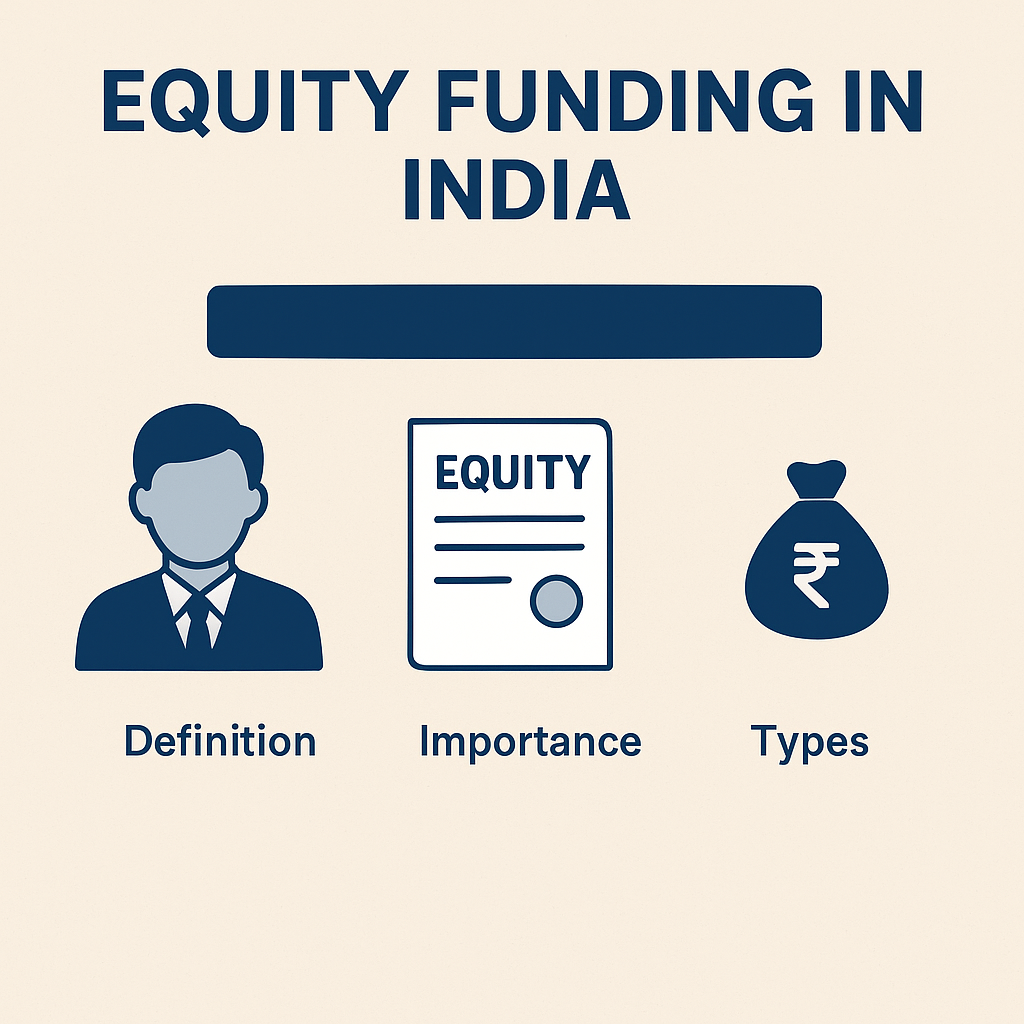
Equity Funding in India refers to raising capital by offering ownership stakes in a company. Instead of borrowing money and repaying it with interest, businesses issue equity shares to investors. These investors gain partial ownership and, in return, benefit when the company grows in value.
This model is especially popular in the Indian startup ecosystem because it allows entrepreneurs to access funds without the immediate burden of loan repayments.
Equity Funding vs Debt Funding
Equity Funding
→ Involves selling ownership stakes; no repayment obligations.
Debt Funding
→ Involves borrowing funds; requires interest and principal repayment.
Equity is more flexible but comes with ownership dilution, while debt maintains control but increases financial pressure.
Importance of Equity Funding in India
Why Startups Prefer Equity Funding
Most Indian startups choose equity funding since it reduces financial stress during their early years. Instead of servicing debt, they reinvest profits into growth.
Role in Business Expansion
Equity capital allows businesses to scale operations, hire talent, and enter new markets.
Equity Funding as a Risk-Sharing Tool
Investors share the financial risk with promoters, ensuring that no single entity carries the full burden.
How Does Equity Funding Work?
Process of Raising Equity Capital
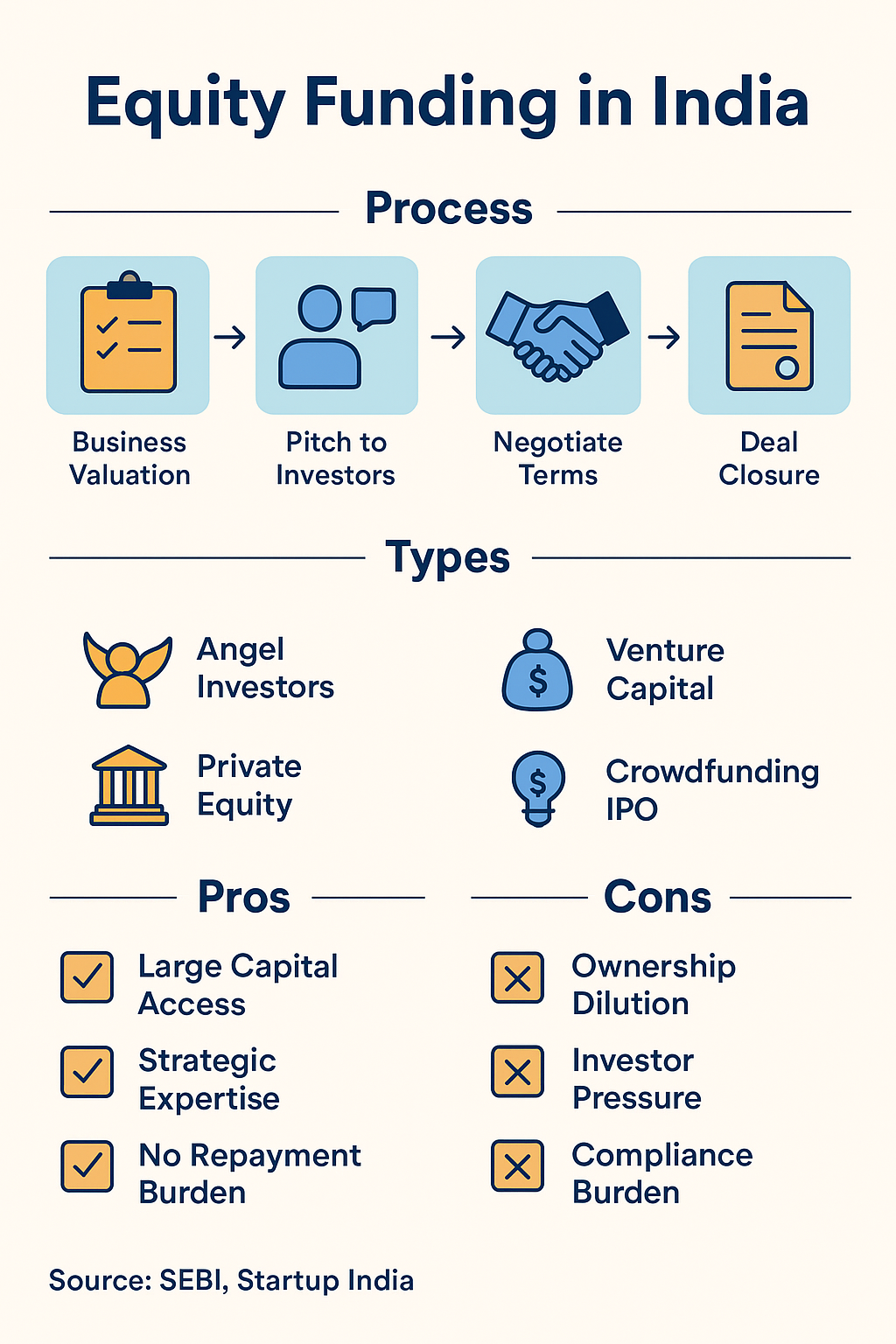
- Business valuation → Determines how much equity to offer.
- Pitching to investors → Through networks, venture capital firms, or angel investors.
- Negotiation → Finalizing terms of ownership, rights, and responsibilities.
- Closing the deal → Signing agreements and transferring funds.
Investor Evaluation and Valuation
Investors evaluate financial performance, scalability, and team strength before investing.
Rights and Responsibilities of Shareholders
Equity investors usually gain voting rights, dividend entitlements, and decision-making powers in strategic areas.
Types of Equity Funding in India
Angel Investment
High-net-worth individuals invest in early-stage startups, often providing mentorship.
Venture Capital
VCs pool money from funds and invest in high-growth startups with scalable business models.
Private Equity
Investments in established companies aiming for restructuring or expansion.
Equity Crowdfunding
A digital method where multiple small investors fund startups through regulated online platforms.
Initial Public Offering (IPO)
When a company goes public by offering shares on stock exchanges like NSE and BSE.
Key Features of Equity Funding
- Ownership dilution for promoters.
- No fixed repayment obligations.
- Investors bring expertise and networks.
- Long-term focus on business growth.
Advantages of Equity Funding
Access to Large Capital
Startups can raise significant amounts without collateral.
Brings Strategic Expertise
Investors often bring experience, market access, and business networks.
Reduces Financial Burden
Unlike loans, there are no monthly repayments, allowing businesses to focus on scaling.
Risks and Challenges of Equity Funding
Loss of Ownership Control
Promoters may lose partial control depending on equity sold.
Pressure from Investors
Shareholders may push for faster growth or exits, creating pressure.
Regulatory and Compliance Burdens
Companies must comply with SEBI, RBI, and Ministry of Corporate Affairs guidelines.
Equity Funding in India’s Startup Ecosystem
Government Schemes Supporting Equity Funding
- Startup India Seed Fund Scheme
- Fund of Funds for Startups (FFS) by SIDBI
Role of Angel Networks and VC Firms
Networks like Indian Angel Network and VC firms like Sequoia, Accel, and Tiger Global are major players.
Equity Funding in Tech Startups
India’s unicorns (Flipkart, Zomato, Paytm, Byju’s) have all leveraged equity capital for rapid growth.
Eligibility and Requirements for Equity Funding
Business Valuation Process
A valuation expert or investor determines company worth based on revenue, assets, and market potential.
Due Diligence and Documentation
Legal, financial, and operational checks are conducted.
Startup Pitch Deck Essentials
Promoters must present a strong pitch deck covering business model, financials, and market opportunity.
Steps to Raise Equity Funding in India
- Identify suitable investors.
- Prepare valuation and pitch materials.
- Negotiate terms (ownership % and valuation).
- Sign agreements and receive funds.
Equity Funding vs Promoter’s Funding
Factor |
Equity Funding |
Promoter’s Funding |
| Ownership | Diluted | Retained |
| Cost of Capital | High (investor share) | Medium (loan interest) |
| Control | Shared with investors | Controlled by promoter |
| Risk | Shared with investors | Promoter bears repayment risk |
Alternatives to Equity Funding
- Debt financing (bank loans, NBFC loans).
- Revenue-based financing (repay via revenue share).
- Government grants and subsidies.
Best Practices for Businesses Raising Equity
- Build a strong and scalable business model.
- Ensure transparency with financial reporting.
- Develop long-term relationships with investors.
Case Studies of Equity Funding in India
Flipkart
Raised billions through venture capital before Walmart’s acquisition.
Zomato
Transitioned from VC funding to a successful IPO in 2021.
Fintech and EdTech Startups
Companies like Razorpay and Byju’s raised large equity rounds to scale globally.
Future of Equity Funding in India
Digital Equity Platforms
Crowdfunding and digital investor platforms are growing.
SEBI’s Role
Regulations are evolving to protect investors while supporting startups.
Global Investors Entering India
Foreign venture funds continue to invest in Indian startups, especially in technology and sustainability.
1. What is Equity Funding in India?
It is the process of raising capital by selling company shares to investors.
2. Who provides equity funding?
Angel investors, venture capital firms, private equity funds, and public investors.
3. What are the benefits of equity funding?
Large capital, expertise, and no repayment burden.
4. What are the risks of equity funding?
Ownership dilution and pressure from investors.
5. Can small businesses raise equity funding?
Yes, through angel investors or crowdfunding platforms.
6. How is equity funding different from loans?
Loans require repayment; equity funding doesn’t but reduces ownership.
Conclusion – Is Equity Funding the Right Choice?
Equity Funding in India is a powerful tool for startups and businesses seeking growth capital. While it dilutes ownership, it offers large-scale funding, strategic expertise, and risk-sharing. For high-growth ventures, equity is often the best path forward.
👉 To learn more, visit SEBI Guidelines or explore related financing options like Promoter’s Funding in India.