

Introduction to Foreign Funding in India
Foreign Funding in India has become one of the most important sources of capital for businesses, startups, and infrastructure development. With India’s growing economy and startup ecosystem, international investors are eager to participate in the country’s success story. Whether through Foreign Direct Investment (FDI), portfolio investments, or external borrowings, foreign funding helps companies access large capital pools, expand globally, and adopt new technologies.
In this article, we’ll explore the process, benefits, challenges, and regulatory framework of Foreign Funding in India.
What is Foreign Funding?
Foreign funding refers to the capital raised by Indian entities from international investors, financial institutions, governments, or organizations. This funding can be in the form of equity investments, debt financing, portfolio investments, or grants.
Key Features of Foreign Funding
Importance of Foreign Funding in India’s Economy
Boosting Startups and SMEs
India’s startup ecosystem thrives on foreign funding. Unicorns like Flipkart, Paytm, and Zomato scaled up due to investments from global venture capitalists.
Role in Infrastructure Development
Foreign investments in roads, ports, and renewable energy have accelerated India’s growth trajectory.
Enhancing Foreign Exchange Reserves
Stable inflows of FDI and FPI strengthen India’s currency reserves, making the economy more resilient.
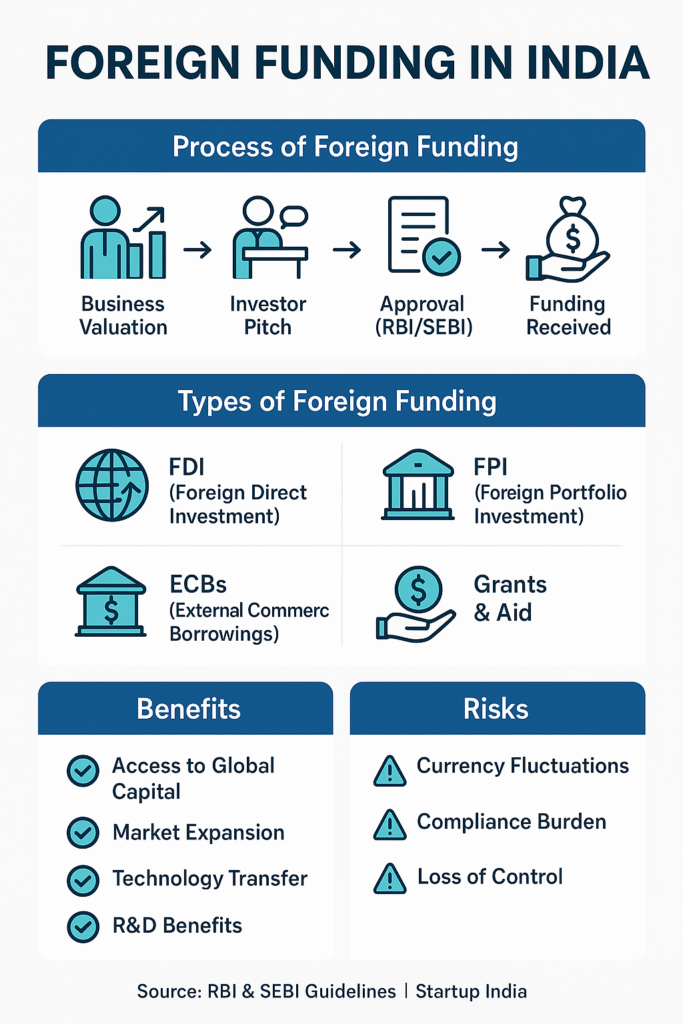
Types of Foreign Funding in India
Foreign Direct Investment (FDI)
Equity investments made by global corporations directly into Indian businesses. Example: Walmart’s acquisition of Flipkart.
Foreign Portfolio Investment (FPI)
Investments in stocks, bonds, and securities by foreign institutional investors.
External Commercial Borrowings (ECBs)
Loans raised from foreign banks and financial institutions by Indian corporates.
Foreign Aid & Grants
Financial support provided by governments or international organizations like the World Bank or IMF.
Process of Securing Foreign Funding in India
Compliance with RBI & SEBI Guidelines
Every transaction must adhere to Foreign Exchange Management Act (FEMA) rules.
Due Diligence & Valuation
Investors review a company’s financial health, business model, and governance.
Approval Routes (Automatic vs. Government)
Automatic Route: No prior government approval needed.
Government Route: Requires clearance from relevant ministries.
Benefits of Foreign Funding
Access to Large Capital: Expands business opportunities.
Global Market Expansion: Provides international reach.
Technology Transfer & Innovation: Boosts competitiveness.
Risks & Challenges of Foreign Funding
-
Exchange Rate Fluctuations: Can impact returns.
-
Compliance Burden & Legal Risks: High due diligence required.
-
Threat to Domestic Control: Over-dependence on foreign capital may reduce sovereignty.
Regulations Governing Foreign Funding in India
Role of RBI
Monitors and regulates capital inflows and outflows.
Role of SEBI
Oversees stock market participation by foreign investors.
FEMA Guidelines
Ensures all cross-border transactions comply with Indian law.
Foreign Funding vs Domestic Funding
Aspect | Foreign Funding | Domestic Funding |
|---|---|---|
| Capital Availability | Larger pool | Limited |
| Ownership Control | Dilution risk | Retained |
| Compliance | Complex | Simpler |
| Cost of Capital | Competitive | Higher |
Case Studies of Foreign Funding in India
Flipkart – Walmart’s investment of $16 billion.
Paytm – Backed by Alibaba and SoftBank.
Zomato – Supported by Ant Financial and Uber.
Best Practices for Indian Businesses Seeking Foreign Funding
Maintain financial transparency
Ensure legal compliance
Build investor confidence
Plan clear exit strategies
FAQs on Foreign Funding in India
Q1: What are the main sources of Foreign Funding in India?
FDI, FPI, ECBs, and grants.
Q2: Is Foreign Funding allowed for startups?
Yes, startups can raise FDI through automatic and government routes.
Q3: What regulations govern Foreign Funding?
FEMA, RBI, and SEBI regulations apply.
Q4: What are the risks of Foreign Funding?
Currency fluctuations, compliance burden, and loss of control.
Q5: Can NGOs in India receive foreign funding?
Yes, but only under FCRA (Foreign Contribution Regulation Act) approval.
Conclusion – The Future of Foreign Funding in India
Foreign Funding in India is a critical growth driver for businesses, startups, and infrastructure. While it provides access to capital, global exposure, and innovation, businesses must also manage risks and comply with regulatory frameworks. With India emerging as a global investment hub, foreign funding will continue shaping the country’s economic growth story.