

Introduction to Alternate Investor’s Fund in India
In India’s fast-evolving investment landscape, Alternate Investor’s Funds (AIFs) have emerged as powerful instruments that go beyond traditional investment vehicles like mutual funds and fixed deposits. These funds allow high-net-worth individuals (HNIs), institutions, and sophisticated investors to diversify their portfolios into private equity, venture capital, hedge funds, and real estate—all within a regulated SEBI framework.
Over the past decade, AIFs have become a cornerstone of India’s alternative finance market. As of 2025, AIFs collectively manage assets worth over ₹10 lakh crore, showing immense investor confidence in this space.
What is an Alternate Investor’s Fund (AIF)?
Definition and Concept of AIFs
An Alternate Investor’s Fund (AIF) is a privately pooled investment vehicle that collects funds from investors to invest in assets as per a defined strategy. These funds operate under SEBI’s AIF Regulations (2012) and are distinct from mutual funds or collective investment schemes.
How AIFs Differ from Mutual Funds and Venture Capital Funds
Aspect | AIF | Mutual Fund | Venture Capital Fund |
|---|---|---|---|
| Investor Type | HNIs, Institutions | Retail, HNIs | Startups & Early-stage firms |
| Risk Level | Moderate to High | Low to Moderate | High |
| Liquidity | Low | High | Very Low |
| Regulation | SEBI AIF Regulations, 2012 | SEBI MF Regulations | SEBI VCF Guidelines |
Evolution of Alternate Investor’s Fund in India
Early Development and Global Inspiration
Globally, alternative investments gained prominence in the early 2000s, driven by hedge funds and private equity. India adopted this model to attract global investors and offer domestic HNIs more sophisticated products.
SEBI’s Role in Structuring the AIF Framework
In 2012, SEBI introduced the Alternate Investment Funds Regulations, defining categories, transparency norms, and investor protections. This marked a turning point for India’s alternative investment sector.
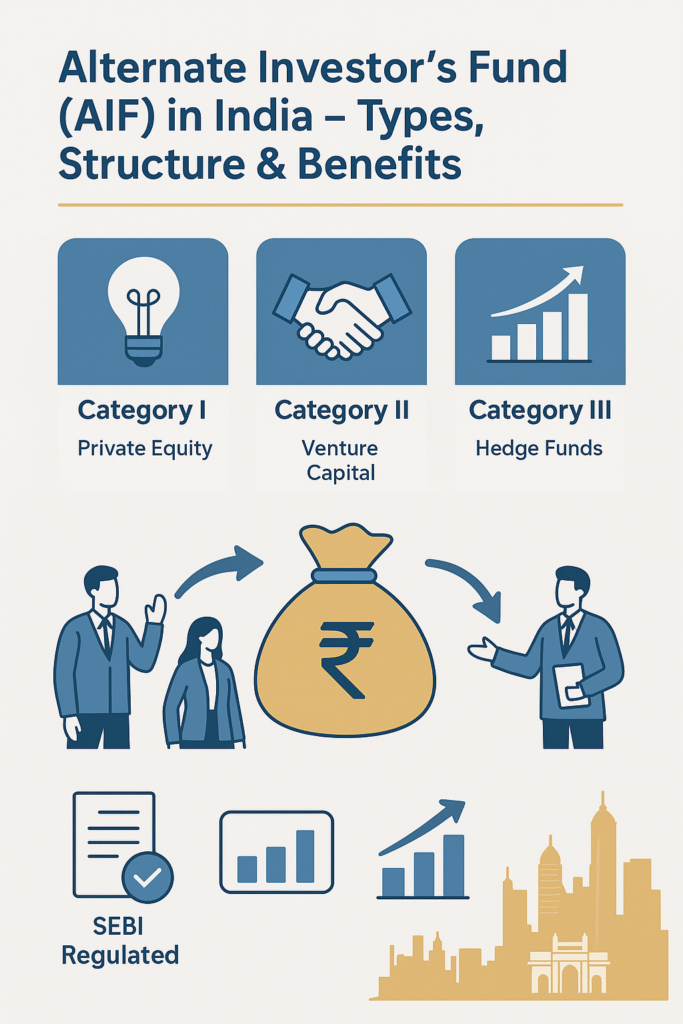
Types of Alternate Investor’s Funds in India
Category I AIF – Startup and SME Focused Funds
Category I AIFs invest in early-stage ventures, startups, social enterprises, and infrastructure. They’re crucial for India’s startup ecosystem and receive regulatory incentives.
Examples: Angel funds, social venture funds, infrastructure funds.
Category II AIF – Private Equity and Debt Funds
These funds invest in unlisted companies, debt instruments, and distressed assets. They do not receive specific incentives or concessions.
Examples: Private equity funds, debt funds.
Category III AIF – Hedge and Complex Strategy Funds
Category III AIFs use complex trading strategies such as derivatives, leverage, and arbitrage to generate short-term gains.
Examples: Hedge funds and multi-strategy funds.
Structure and Working of Alternate Investor’s Funds
Fund Structure: Trust, LLP, or Company
An AIF can be set up as a trust, limited liability partnership (LLP), or a company. Most Indian AIFs prefer the trust model due to operational flexibility.
Investor Participation and Minimum Investment Criteria
Minimum investment: ₹1 crore per investor
For employees/directors: ₹25 lakh minimum
AIFs can have up to 1,000 investors per scheme
Fund Managers, Custodians, and Trustees
The fund manager makes investment decisions, while trustees ensure compliance with SEBI regulations. Custodians handle asset safekeeping and reporting.
Benefits of Alternate Investor’s Funds
Portfolio Diversification
AIFs provide exposure to non-traditional assets, reducing dependence on equities and bonds.
Access to High-Growth Assets
Investors can participate in India’s booming private equity, venture capital, and infrastructure sectors.
Professional Fund Management
AIFs are managed by experienced professionals with sector expertise and research-based strategies.
Tax Efficiency and Long-Term Gains
Certain AIFs offer pass-through taxation, where profits are taxed only at the investor level, improving overall returns.
Key Risks Associated with AIFs
Market Volatility
Alternative investments are exposed to economic and sector-specific fluctuations.
Illiquidity Risk
AIFs usually have a lock-in period of 3 to 7 years, making early withdrawals difficult.
High Entry Threshold
The ₹1 crore minimum investment makes AIFs inaccessible for retail investors.
Regulatory Complexity
Frequent compliance requirements and evolving SEBI norms can challenge smaller fund houses.
SEBI Regulations on Alternate Investor’s Funds
Registration Process and Categories
All AIFs must register under SEBI (Alternative Investment Funds) Regulations, 2012. They’re categorized based on investment strategy and risk exposure.
Disclosure Norms and Governance Standards
Funds must disclose their investment strategy, risk factors, and valuation policies before soliciting investors.
Investment Limits and Reporting Obligations
SEBI mandates quarterly reporting of fund performance, portfolio valuation, and investor disclosures.
Popular AIFs in India and Their Impact
Domestic Private Equity Funds
Firms like ICICI Venture, Kotak PE, and ChrysCapital have supported India’s mid-market growth story.
Venture Capital Funds in Startups
Funds such as Nexus Venture Partners and Blume Ventures have powered India’s startup boom.
Real Estate and Infrastructure AIFs
These funds bridge the financing gap in India’s real estate and infrastructure sectors.
Comparison: AIF vs Mutual Funds vs PMS
Criteria | AIF | Mutual Fund | Portfolio Management Services (PMS) |
|---|---|---|---|
| Minimum Investment | ₹1 crore | ₹500 | ₹50 lakh |
| Liquidity | Low | High | Medium |
| Regulation | SEBI AIF Regulations | SEBI MF Regulations | SEBI PMS Regulations |
| Strategy | Private market focus | Public market focus | Custom portfolio |
| Risk Level | Moderate to High | Low to Moderate | Moderate |
How to Invest in an Alternate Investor’s Fund
Eligibility Criteria for Investors
Only HNIs, family offices, and institutional investors can invest directly in AIFs.
Due Diligence and Fund Selection
Investors should evaluate:
Fund manager’s track record
Investment strategy and risk profile
Fee structure and exit options
Taxation Aspects for AIF Investors
Category I & II AIFs: Pass-through taxation
Category III AIFs: Taxed at fund level
Always consult a tax advisor before investing.
The Future of AIFs in India
Emerging Sectors for Investment
AIFs are increasingly targeting clean energy, fintech, agritech, and deep tech startups.
Digital Platforms and Transparency
Fintech platforms like Smallcase, Tyke, and Grip Invest are simplifying AIF access for smaller investors.
Global Capital Flow and India’s Growth Story
Foreign investors view AIFs as a gateway to India’s robust private markets, especially in infrastructure and technology.
FAQs on Alternate Investor’s Funds in India
1. What is an Alternate Investor’s Fund (AIF)?
An AIF is a private investment vehicle regulated by SEBI that invests in alternative assets such as private equity, startups, and hedge funds.
2. Who can invest in AIFs in India?
Only accredited investors, HNIs, and institutional investors with a minimum investment of ₹1 crore can participate.
3. How are AIFs different from mutual funds?
Unlike mutual funds, AIFs invest in unlisted securities and alternative assets with higher risk and longer lock-in periods.
4. Are AIFs regulated by SEBI?
Yes, SEBI strictly regulates AIF registration, governance, and investor protection under the AIF Regulations of 2012.
5. What are the risks of investing in AIFs?
High risk, low liquidity, and regulatory complexity make them suitable only for experienced investors.
High risk, low liquidity, and regulatory complexity make them suitable only for experienced investors.
Yes, under FEMA guidelines, foreign investors can invest in SEBI-registered AIFs subject to RBI approval.
Conclusion – Role of AIFs in India’s Financial Ecosystem
The rise of Alternate Investor’s Funds in India marks a significant shift in the country’s financial ecosystem. By channeling private capital into innovative sectors and unlisted businesses, AIFs are bridging the gap between investors and emerging opportunities. With a strong regulatory foundation and growing investor interest, AIFs will continue to fuel India’s next wave of economic growth.