
Let me be straight with you 2026 is not a great year to be unprepared when you’re out raising.
Not because capital dried up. It hasn’t. India is actually swimming in it right now. The problem is that everyone else is also raising, and investors have gotten a lot more selective about where that capital goes. We’ve sat across the table from enough founders to know that the ones who struggle aren’t usually struggling because their business is bad. They’re struggling because they came in without a real strategy.
So here’s what actually works. Not theory. Stuff we see moving.
1. Bridge funding before the big round
We almost always recommend this and founders almost always push back at first. “I don’t want to do a small round, I want to do the real one.”
Here’s the thing though. A bridge even ₹50 lakhs, even ₹1 crore buys you 4 to 6 months of proof. And proof changes your entire negotiating position. You go from “trust me, here’s our projection” to “look at what we did.” That shift is worth more than most founders realize until they’ve been through it once.
2. Equity funding – timing matters more than the idea
Everyone wants equity. Makes sense. No repayment, meaningful capital, and a partner who has skin in the game alongside you.
But equity investors in 2026 are extremely focused on fundamentals. Not vision, not market size slides actual unit economics. If you can’t explain your CAC, your payback period, your gross margins without looking at notes, you’re not ready yet. And going early with a weak story doesn’t just lose you that meeting it can quietly close doors you didn’t know were closing.
When the numbers are there though? Equity funding is genuinely the fastest way to scale.
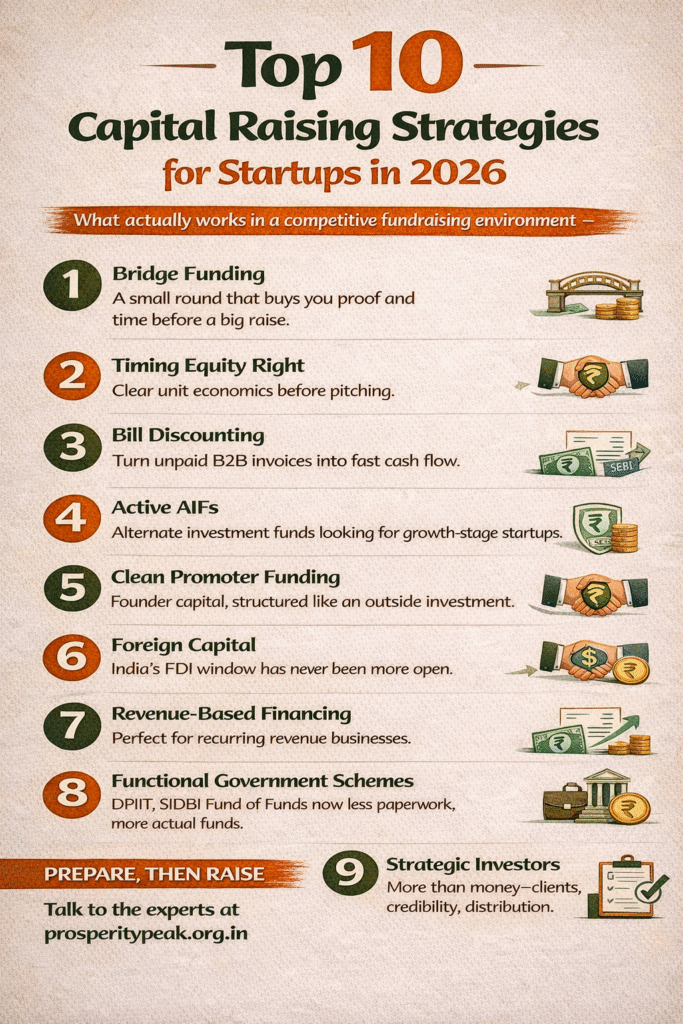
3. Bill discounting – nobody talks about this enough
If your startup sells to other businesses and you’re waiting 30, 60, 90 days to get paid -you’re essentially financing your clients’ operations for free.
Bill discounting lets you convert those pending invoices into cash today. No dilution. No new loan on the books really. Just your own money, earlier. For B2B startups especially this can quietly solve a cashflow problem that’s been dragging on for months.
4. AIFs are worth your time now
Three years ago when founders asked about Alternate Investment Funds we’d say – maybe, depends on the fund. Now we say this much more confidently: Category II AIFs in India have become genuinely active in the startup space.
They’re SEBI regulated, they often move faster than traditional PE funds, and many of them are specifically looking at growth-stage companies in the ₹5 crore to ₹50 crore revenue range that larger funds don’t touch. If you haven’t mapped the AIF landscape, you’re probably missing a whole category of potential capital.
5. Promoter funding – only if you structure it right
Founders putting their own money in is fine. It’s actually a good signal to outside investors when it’s done properly.
Where it goes wrong is when it’s messy -different tranches at different valuations, no formal documentation, unclear whether it’s debt or equity. Outside investors see a cap table like that and they get nervous. Clean it up. Structure it like you would a third-party investment and it becomes a strength, not a question mark.
6. Foreign capital -the window is genuinely open
India’s FDI environment has improved more in the last 18 months than it did in the five years before that. Global funds that were India-curious are now India-active.
Sectors getting the most attention internationally right now – fintech infrastructure, climate, agri, healthtech. If your startup sits in or adjacent to any of these, there’s a real conversation to be had with foreign investors. ECBs are also worth looking at if you need debt capital and can handle foreign currency exposure. The rates and tenures can be considerably better than domestic options.
7. Revenue-based financing – underrated for the right profile
This one divides opinion. Some founders love it, some don’t like the repayment structure.
The honest take on it works really well for a specific type of business. Recurring revenue, reasonable churn, predictable MRR growth. SaaS companies, subscription D2C, edtech platforms. If that’s you, RBF can close faster than almost any other option and you give up nothing in equity. If your revenue is lumpy or project-based it’s probably not the right fit.
8. Government schemes – stop dismissing them
We get it. The reputation is paperwork, delays, and nothing actually coming through.
But DPIIT, SIDBI’s Fund of Funds, Startup India – these have genuinely gotten better. The Fund of Funds now routes capital through real SEBI-registered AIFs. DPIIT recognition still gives you tax exemptions and makes certain regulatory processes faster. For a founder in the early stages, stacking this on top of your private raise isn’t a fallback -it’s just good structuring.
9. Strategic investors
A cheque from a strategic investor is different from a cheque from a financial investor. The money is the same but everything else isn’t.
A strategic partner opens doors – clients, distribution, credibility, sometimes an acqui-hire path if the relationship develops. More Indian corporations are running internal venture arms now than at any point before. If your product genuinely solves something for a larger player in your sector, that conversation is worth having even if the valuation isn’t as aggressive as a pure financial investor would offer.
10. Sort your advisory and documentation before you go out
This last one. Please take it seriously.
We’ve watched founders walk into rooms with messy cap tables, models that don’t reconcile, valuations they can’t defend, and pitch narratives that don’t match their financials. It doesn’t matter how good the business is at that point – the investor’s confidence is already shaken.
Transaction advisory and proper valuation work isn’t just paperwork. It changes how investors perceive you before they’ve even asked a question. It removes friction from due diligence. It tells the room that you take this seriously. And in competitive funding environments, perception matters enormously.
Look – capital is available in India right now. Genuinely. The market is active, foreign and domestic money is both looking for places to go, and good businesses are getting funded.
What’s scarce isn’t capital. It’s preparation. It’s founders who’ve done the work before they start pitching.
That’s exactly what we help with at Prosperity Peak. Whether you’re figuring out which structure fits your stage, navigating an equity raise, or just trying to understand your options before committing to one – come talk to us before you start knocking on doors.