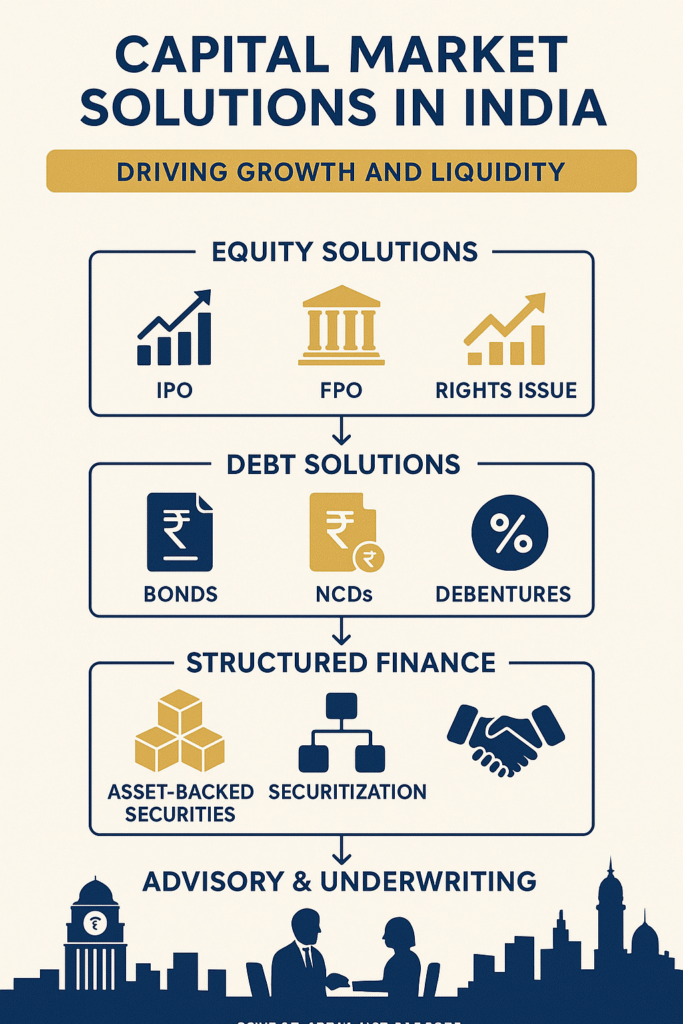
Capital Market Solutions in India play a crucial role in channeling savings into productive investments. They connect investors with businesses that need capital for expansion, modernization, and innovation. Whether through equity, debt, or structured finance, India’s capital markets are the foundation of economic growth.
Introduction to Capital Market Solutions in India
What Are Capital Market Solutions?
Capital Market Solutions refer to financial services that help organizations raise funds from the market, manage liquidity, and optimize their capital structure. These include public offerings, bond issuances, private placements, and securitization.
Importance of Capital Markets in the Indian Economy
Capital markets in India facilitate long-term financing for businesses and infrastructure projects while giving investors an opportunity to earn market-linked returns. With SEBI’s evolving regulatory framework, these solutions have become more transparent, efficient, and investor-friendly.
Structure of Capital Markets in India
Primary Market – Fundraising Through IPOs and Private Placements
The primary market allows companies to raise new capital through Initial Public Offerings (IPOs), Follow-on Public Offerings (FPOs), and Private Placements. This segment is vital for startups and mid-sized enterprises aiming to expand.
Secondary Market – Trading and Liquidity
The secondary market—represented by exchanges like NSE and BSE—provides liquidity and valuation to existing securities. Investors can buy and sell shares, bonds, and other instruments, ensuring continuous market activity.
Role of SEBI, NSE, and BSE
SEBI (Securities and Exchange Board of India) ensures investor protection and fair market practices.
NSE (National Stock Exchange) and BSE (Bombay Stock Exchange) provide transparent platforms for trading and listing.
Key Capital Market Solutions in India
Equity Capital Solutions
IPOs, FPOs, and Rights Issues
Equity capital solutions enable companies to raise funds by offering ownership shares. IPOs bring companies to the public for the first time, while FPOs and rights issues allow further fundraising.
Private Equity and Venture Capital
Private equity funds and venture capital firms invest in promising businesses, especially in the technology, healthcare, and renewable energy sectors. These funds provide strategic support along with capital.
Debt Capital Solutions
Corporate Bonds and Debentures
Debt instruments like corporate bonds and debentures allow businesses to borrow from investors with a promise to repay at maturity. These instruments are ideal for long-term financing without diluting ownership.
Commercial Papers and NCDs
Commercial Papers (CPs) and Non-Convertible Debentures (NCDs) provide short- to medium-term funding options for working capital needs, regulated under SEBI and RBI frameworks.
Structured Finance Solutions
Asset-Backed Securities and Securitization
Structured finance allows pooling of assets like loans or receivables, converting them into tradable securities. This helps companies unlock liquidity and reduce credit risk exposure.
Credit Enhancement and Risk Mitigation Tools
Financial institutions often use credit enhancement tools, such as guarantees and insurance, to make debt instruments more attractive to investors.
Advisory and Underwriting Services
Role of Merchant Bankers and Advisors
Merchant bankers guide companies through the entire fundraising process—valuation, regulatory approvals, and investor relations.
Syndication and Capital Structuring
Banks and financial advisors structure complex deals through syndication, enabling multi-investor participation for large infrastructure or industrial projects.
Benefits of Capital Market Solutions for Indian Businesses
Access to Long-Term Capital: Enables expansion and modernization.
Enhanced Liquidity: Secondary markets allow easy entry and exit for investors.
Diversification: Multiple funding avenues reduce dependency on traditional loans.
Transparency: SEBI’s strict governance enhances trust and accountability.
Challenges Facing Capital Market Solutions in India
Regulatory Compliance
SEBI’s disclosure norms, though necessary, can be complex for small issuers.
Market Volatility
Fluctuating interest rates and global uncertainty impact investor sentiment.
Limited Awareness
Retail investors often lack understanding of advanced market instruments.
Role of SEBI and RBI in Strengthening Capital Markets
SEBI’s Reforms
SEBI has introduced reforms such as ASBA, T+1 settlement, and E-KYC, improving transparency and efficiency.
RBI’s Role in Debt Market Development
RBI’s initiatives like the Retail Direct Gilt platform and repo market reforms enhance participation in debt markets.
Future Outlook: Emerging Trends in Capital Market Solutions
Digital Platforms: E-IPO and online trading systems are simplifying access.
Green Bonds and ESG Investing: Aligning sustainability with profitability.
Global Capital Inflows: Increased FDI and FPI participation boosting market depth.
Comparison: Capital Market vs Money Market
Feature
Capital Market
Money Market
Duration
Long-term (>1 year)
Short-term (<1 year)
Instruments
Shares, Bonds, Debentures
Treasury Bills, CPs, CDs
Risk & Return
Higher risk, higher return
Lower risk, lower return
Regulation
SEBI & RBI
RBI
How to Choose the Right Capital Market Solution
Assess Business Goals: Define whether funding is needed for growth, debt repayment, or working capital.
Evaluate Risk Appetite: Choose between equity (ownership dilution) or debt (repayment obligation).
Seek Expert Advice: Consult SEBI-registered advisors or merchant bankers.
Review Compliance: Ensure adherence to disclosure and listing requirements.
FAQs on Capital Market Solutions in India
1. What are Capital Market Solutions?
They are financial mechanisms like IPOs, bonds, and structured finance used to raise funds from investors.
2. How do capital markets support economic growth?
They channel savings into productive investments, boosting GDP and job creation.
3. What is the difference between equity and debt capital?
Equity represents ownership; debt represents borrowed funds repayable with interest.
4. Who regulates the capital markets in India?
SEBI oversees equity markets, while RBI plays a key role in debt and money markets.
5. Can startups access capital market solutions?
Yes, via SME platforms on NSE and BSE, and through venture capital under AIFs.
6. Are capital market investments risky?
Yes, but risks can be managed through diversification, professional advice, and compliance.
Conclusion – The Future of Capital Market Solutions in India
Capital Market Solutions in India are transforming the financial landscape. They empower businesses with liquidity, transparency, and access to a global investor base. As digitalization, ESG investing, and regulatory reforms progress, India’s capital markets will remain central to sustainable economic development.