Introduction to Transaction Advisory & Valuations in India
In today’s fast-evolving Indian business landscape, Transaction Advisory & Valuations play a crucial role in guiding companies through mergers, acquisitions, fundraising, and restructuring. Whether it’s a large corporate deal or a startup equity infusion, professional advisory ensures that each transaction is strategically sound, financially viable, and compliant with regulations.
India’s growing economy, coupled with increased investor confidence, has made the need for accurate valuations and expert deal advisory more vital than ever. From private equity firms to family-owned businesses, everyone now seeks data-backed insights before making financial commitments.
What Is Transaction Advisory?
Transaction Advisory refers to the strategic, financial, and operational consulting provided during a business deal. These services help companies evaluate opportunities, mitigate risks, and execute transactions efficiently.
Advisory professionals support clients across multiple stages — from due diligence and deal structuring to integration and post-merger value creation. In India, this service is particularly critical due to diverse regulatory frameworks and dynamic market conditions.
Why Valuation Is Critical in Business Transactions
A valuation determines the fair market value of a business or its assets. It’s the foundation for all major financial decisions, including acquisitions, fundraising, or even succession planning.
Inaccurate valuations can lead to overpayment, disputes, or missed opportunities. Professional valuation ensures fairness and transparency — both of which are essential in India’s regulated financial ecosystem under SEBI and ICAI norms.
The Role of Transaction Advisory Services in India
Supporting Mergers & Acquisitions (M&A)
Transaction advisors act as strategic partners during M&A deals — identifying targets, negotiating terms, and ensuring financial synergy between the entities. Their insights help bridge valuation gaps and structure deals that create long-term value.
Financial Due Diligence & Risk Assessment
Due diligence uncovers hidden financial, legal, or operational risks. Advisors analyze historical performance, contracts, and liabilities, ensuring buyers and investors make informed decisions.
Structuring & Negotiation Support
In India, structuring deals efficiently helps minimize tax implications and align with FDI regulations. Advisors draft models and frameworks that balance compliance with commercial goals.
Types of Valuation Services in India
Business Valuation for M&A and Joint Ventures
These valuations help determine the fair exchange ratio in mergers or stake sales, based on future cash flow and asset potential.
Startup and Fundraising Valuation
Startup valuations in India often rely on potential revenue and scalability, rather than historic data — crucial for attracting angel investors and venture capitalists.
Intangible Asset and Brand Valuation
Brands, patents, and intellectual property are often as valuable as tangible assets. Advisory firms quantify their worth using revenue contribution and market reputation models.
Fairness Opinions & Regulatory Valuations
Independent opinions on deal fairness are often required under SEBI and RBI guidelines for listed entities or cross-border mergers.
Valuation Methodologies Used by Professionals
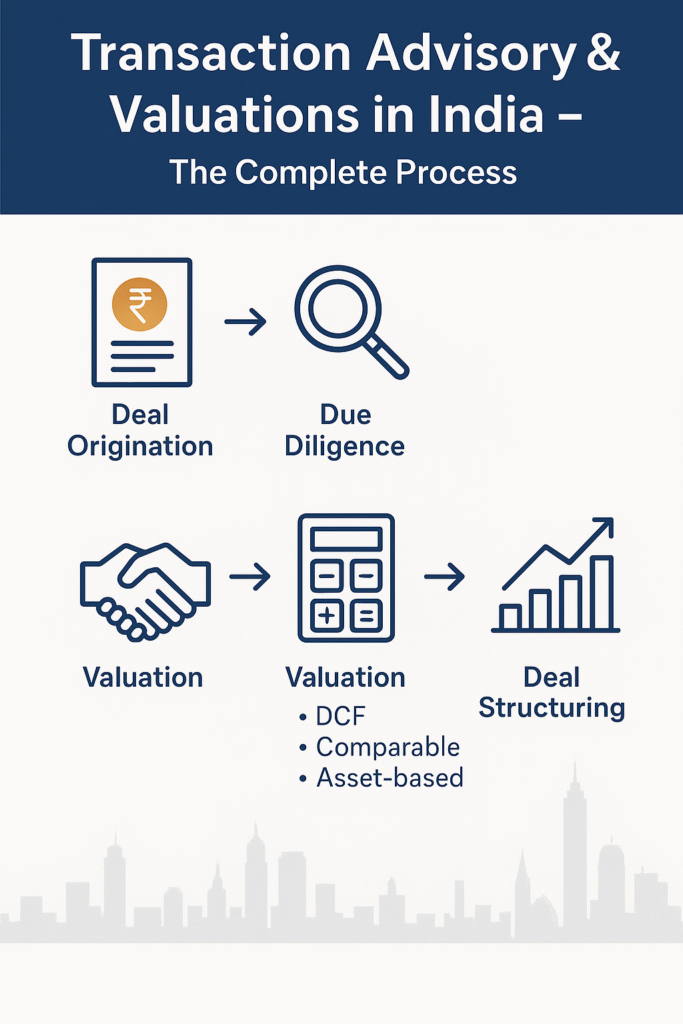
1. Discounted Cash Flow (DCF) Method
Projects future cash flows and discounts them to present value — ideal for growth-stage businesses.
2. Comparable Company Analysis (CCA)
Compares the target firm’s performance with similar publicly listed companies to derive a market-based value.
3. Precedent Transaction Analysis (PTA)
Assesses value based on past transactions in the same sector — commonly used for mergers and acquisitions.
4. Asset-Based Valuation
Focuses on the company’s balance sheet, net assets, and replacement costs — often used for asset-heavy industries like manufacturing.
Key Steps in the Transaction Advisory Process
Deal Origination and Opportunity Assessment – Identifying potential targets or investors.
Due Diligence and Risk Evaluation – Conducting detailed analysis of financial, legal, and tax records.
Deal Structuring and Negotiation – Developing the best financial and operational structure for the deal.
Post-Deal Integration & Value Creation – Aligning teams, processes, and systems for synergy realization.
Regulatory Framework for Valuations in India
SEBI Regulations and Compliance Norms
Valuations for listed companies must comply with SEBI (ICDR) and Takeover Code norms to ensure transparency.
ICAI Valuation Standards
The Institute of Chartered Accountants of India (ICAI) has defined standards and certification norms for Registered Valuers, ensuring consistency.
Role of RBI and Companies Act
Cross-border and FDI transactions fall under RBI oversight, while Section 247 of the Companies Act, 2013, governs domestic valuations.
Tools & Technologies in Modern Valuations
Modern valuation firms are embracing AI, automation, and data visualization tools.
Financial Modelling Tools: Excel-based and cloud systems that simulate multiple business scenarios.
AI-Driven Valuation Platforms: Predict outcomes using big data and machine learning.
Virtual Due Diligence Rooms: Secure online platforms to share and analyze sensitive deal documents.
Benefits of Professional Transaction Advisory & Valuation Services
Informed Decision-Making: Provides accurate financial insights.
Enhanced Deal Efficiency: Streamlines negotiation and approval processes.
Compliance and Risk Mitigation: Ensures adherence to Indian and international regulations.
Accurate Value Discovery: Helps all stakeholders agree on a fair, data-backed valuation.
Challenges in Transaction Advisory & Valuations in India
Despite progress, several hurdles remain:
Regulatory Complexity — Navigating SEBI, RBI, and tax laws simultaneously.
Market Volatility — Fluctuating valuation multiples due to macroeconomic uncertainty.
Data Gaps — Lack of consistent disclosure standards for private companies.
The Future of Transaction Advisory & Valuations in India
India’s M&A and investment landscape is evolving toward digital transformation, ESG compliance, and cross-border collaboration.
ESG-Driven Valuations will soon become standard for sustainability-conscious investors.
AI & Blockchain Integration will enhance data accuracy and transparency.
Global Partnerships will make Indian firms more attractive to foreign investors.
FAQs on Transaction Advisory & Valuations in India
Q1. What are Transaction Advisory Services?
They assist companies in buying, selling, or restructuring businesses with strategic, financial, and regulatory guidance.
Q2. Why are valuations important in India?
Valuations ensure fairness, transparency, and compliance during M&A, investment, or fundraising deals.
Q3. Who can perform valuations in India?
Only Registered Valuers under IBBI and ICAI can legally perform valuations for companies.
Q4. Which industries rely most on these services?
Sectors like manufacturing, fintech, healthcare, and renewable energy commonly use transaction advisory support.
Q5. How often should a company update its valuation?
Ideally every 12–18 months or during major capital or ownership changes.
Q6. What’s the difference between DCF and market-based valuation?
DCF focuses on intrinsic value, while market-based methods compare similar companies or transactions.
Conclusion – Building Confidence and Value in Every Deal
In the dynamic Indian economy, Transaction Advisory & Valuations are more than just financial assessments — they’re strategic enablers. Whether guiding a startup’s fundraising journey or managing a billion-rupee merger, these services ensure accuracy, compliance, and value creation at every step.
For more on corporate valuation standards, visit the ICAI Valuation Standard Board.